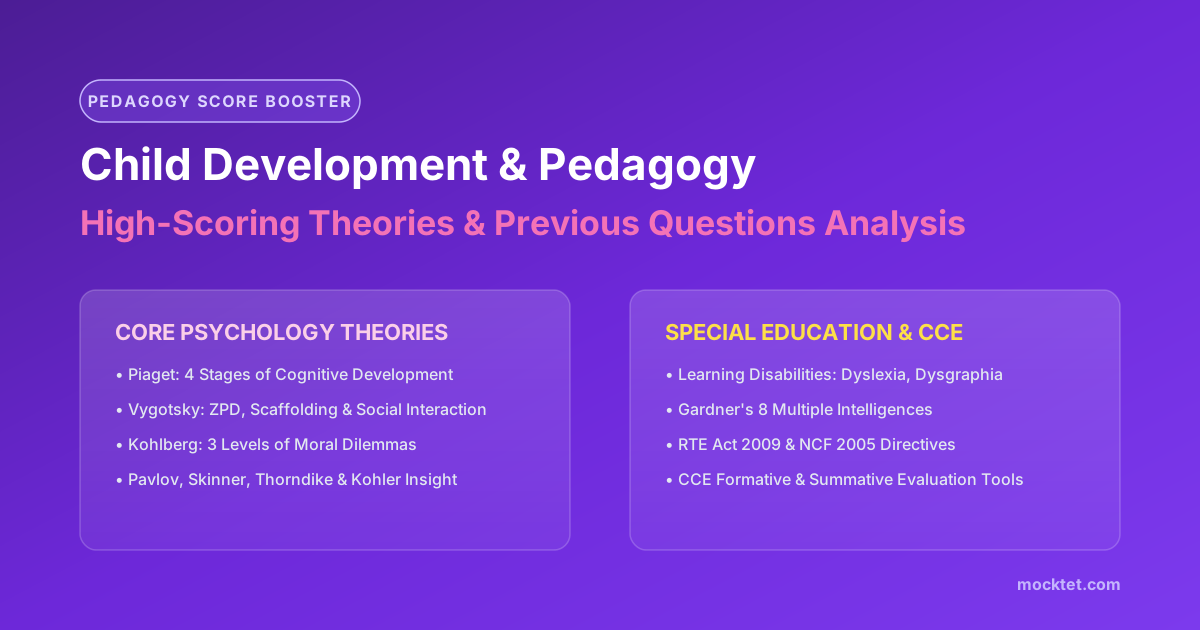
Child Development & Pedagogy (CDP): High-Scoring Topics & Previous Questions Analysis
In-Depth Analysis of Cognitive Theories, Learning Disabilities, Inclusive Education, and CCE

Dr. K. Srinivas Rao
Senior Pedagogy Faculty & TET Exam Analyst
Key Takeaways & Quick Facts (Direct Summary)
- ✓CDP accounts for 30 marks in both Paper 1 and Paper 2 and is the highest-leverage section for scoring.
- ✓Piaget, Vygotsky, and Kohlberg consistently yield 6 to 8 direct questions in every TET question paper.
- ✓Special education questions focus on Dyslexia (reading), Dysgraphia (writing), and Dyscalculia (maths).
- ✓The golden rule for pedagogy MCQs: Always select the answer that respects child-centered, experiential learning over rote memorization.
- ✓Understanding CCE formative vs summative evaluation tools guarantees 3 to 4 easy marks.
Table of Contents
1. Why CDP Determines Your TET Rank
Child Development & Pedagogy (30 Marks) is identical in weightage across Paper 1 and Paper 2. More importantly, understanding pedagogical principles gives you an edge in the methodology questions of Telugu, English, Maths, Science, and Social Studies, which together account for another 30 marks across the paper!
2. The Big 3 Cognitive Theorists Compared
| Theorist | Core Construct | Key Stages / Concepts | Frequent Exam Questions |
|---|---|---|---|
| Jean Piaget | Cognitive Constructivism | Sensory-motor (0-2y), Pre-operational (2-7y), Concrete (7-11y), Formal (11y+) | Conservation, Object Permanence, Egocentrism, Assimilation & Accommodation |
| Lev Vygotsky | Socio-Cultural Theory | Zone of Proximal Development (ZPD), Scaffolding, More Knowledgeable Other (MKO) | Private speech, peer collaboration, cultural tools in cognitive development |
| Lawrence Kohlberg | Moral Development | Pre-conventional (Punishment/Reward), Conventional (Good boy/Law & Order), Post-conventional (Social contract) | Heinz Dilemma, moral reasoning stages, universal ethical principles |
3. Inclusive Education & Learning Disabilities
TET papers place strong emphasis on recognizing diverse learners in mainstream classrooms:
- Dyslexia: Difficulty in phonological processing, word decoding, and reading fluency.
- Dysgraphia: Impairment in fine motor coordination and handwriting formation.
- Dyscalculia: Difficulty understanding numbers, mathematical symbols, and basic arithmetic.
- ADHD: Attention Deficit Hyperactivity Disorder characterized by impulsivity and short attention span.
Frequently Asked Questions
How do I choose between two answers that both seem psychologically plausible?
Choose the option that empowers student agency, collaboration, and intrinsic motivation over teacher-dominated control or rote memorization.
Practice Child Development & Pedagogy Quiz
Experience the full 150-question CBT exam environment with authentic syllabus questions, real countdown timer, and instantaneous performance scorecards.